
Employer Branding Challenges and Our Guide to Solutions for 2026
Explore the top 10 employer branding challenges companies face and discover actionable strategies to overcome them. From crafting a clear EVP to navigating hybrid work models, learn how to build a compelling and authentic employer brand that attracts, retains, and engages top talent in today’s competitive market.

In today’s talent market, a great salary or a premium infrastructure isn’t enough to win people anymore, and your employer branding plays a crucial role in attracting and retaining top talent.
However, according to the OECD Economic Output Report, 70% to 85% of firms reported difficulties in recruiting suitable workers in 2024, highlighting the urgency of addressing these issues.
Here’s the reality: building an employer brand has never been tougher. From hybrid work tensions to rising expectations around well-being and inclusion, companies everywhere are struggling to stay engaging and attractive.
These obstacles often result in high turnover, difficulty filling key roles, and a tarnished reputation, making it harder for companies to stand out in the talent market.
Understanding the causes behind these challenges is the first step in creating a more attractive and authentic employer brand.
By addressing these issues, organizations can improve their ability to attract and retain top talent and foster long-term employee engagement.
In this blog, we’ll explore the top 10 employer branding challenges and provide actionable insights on how to overcome them to build a compelling, authentic employer brand.
Understanding Employer Branding Challenges and Their Causes
Employer branding challenges arise when companies struggle to differentiate themselves in a competitive talent market. Issues like poor reputation, lack of transparency, and ineffective communication can hinder recruitment and employee retention.
These challenges make it difficult for organizations to attract and retain top talent. Common problems include misalignment between brand promises and employee reality, weak employer branding communications, negative online reviews, slow hiring processes, unclear pay transparency, weak diversity efforts, and inconsistent hybrid work policies.
Successful brands build trust through authentic communication, visible leadership, and a positive candidate experience. Measuring results through application quality, retention rates, and review scores helps teams identify gaps and strengthen their employer brand effectively.
Here are some of the key causes behind employer branding challenges:
- Misalignment between corporate and employer brand messaging:
- Evolving candidate expectations
- Limited data visibility
- Hybrid work models
- Budget and leadership buy-in constraints
Addressing these causes is critical to creating a strong, authentic employer brand that attracts and retains top talent. Once the underlying causes are clear, the real work begins, tackling the challenges that hold employer brands back from standing out.
Top 10 Employer Branding Challenges Companies Face
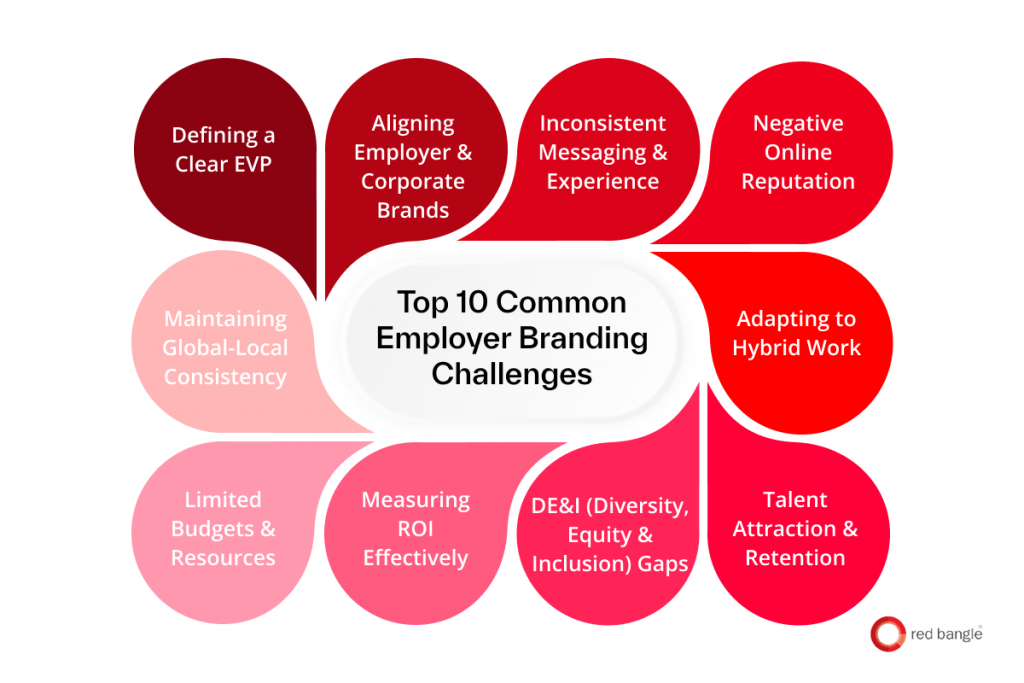
Building a compelling employer brand is crucial for attracting and retaining the best talent. However, companies face numerous challenges in creating a brand that not only appeals to potential hires but also reflects their internal culture and values.
In this section, we explore the top 10 employer branding challenges, providing real-world campaigns and actionable insights for overcoming these obstacles.
1. Crafting a Clear EVP (Employer Value Proposition)
A well-defined Employer Value Proposition (EVP) is the cornerstone of any employer branding strategy. It communicates the unique benefits and values a company offers to its employees. But without a clear EVP, organizations often fail to convey what sets them apart, which can lead to disengagement and high turnover.
One strong example is Unilever. Its global tagline- “A Better Business. A Better World. A Better You’’ captures a broader narrative: when you join Unilever, you’re part of a movement to make a meaningful impact, and you’ll advance your own growth as well.
The company emphasises purpose-driven work, personal development (leadership growth), and sustainable impact. These themes are embedded in its EVP pillars (e.g., “Purpose Power”, “Be the Catalyst”, “Brilliantly Different Together”) and inform both its internal employee experience and external employer brand communications.
2. Aligning Employer Brand with Corporate Brand
A consistent employer brand aligned with the corporate brand is essential for building trust and clarity among potential candidates.
If a company’s employer branding differs from its corporate brand messaging, it can create confusion, erode trust, and make it difficult for candidates to fully understand what the company stands for.
A unified approach ensures that both internal and external audiences perceive the organization as authentic and cohesive. It strengthens the narrative that the company not only delivers value to customers but also provides meaningful growth opportunities to its employees.
A great example of this alignment is Patagonia, whose corporate message, “We’re in business to save our home planet,” is deeply reflected in its employer brand. The company’s culture promotes environmental activism, flexible work to encourage outdoor living, and paid time off for volunteering on ecological projects.
This consistency between what Patagonia says publicly and what it practices internally reinforces its authenticity and attracts like-minded talent.
To achieve this kind of coherence, leading companies are investing in integrated branding strategies and collaborating with the right B2B brand campaign agency to ensure their visual identity, messaging, and tone remain consistent across recruitment campaigns, career pages, and employee communications.
3. Inconsistent Messaging & Candidate Experience
Inconsistent messaging during the recruitment process can confuse and frustrate candidates, leading to disengagement. When candidates feel ignored or misled, they often share their experiences publicly, amplifying reputational damage.
As per Greenhouse’s State of Job Hunting Report (2024), around 61% of candidates report being ghosted after interviews, which underscores how inconsistent communication can harm a company’s employer brand and long-term talent pipeline.
Infosys addressed this issue by launching the “Know Your Recruiter” series in collaboration with Red Bangle, which featured recruiters sharing their personal insights into the hiring process.
This initiative helped make the recruitment experience more authentic and transparent by giving candidates a glimpse into the recruiter’s perspective, fostering a deeper connection.
The result was a more relatable and transparent candidate experience that aligned with Infosys’ employer brand, making it easier for candidates to trust and connect with the company.
Take a closer look at the Infosys campaign.
4. Poor Online Reputation & Employee Reviews
An organization’s online reputation has become a defining factor in attracting and retaining top talent. Today, candidates no longer rely solely on job descriptions or recruiter messages; they actively research companies before deciding to apply.
According to LinkedIn, 75% of job seekers consider an employer’s brand before even submitting an application, underscoring the importance of cultivating transparency and authenticity online.
Negative reviews, inconsistent messaging, or a lack of cultural insight can quickly discourage potential candidates. When an organization fails to engage with employee feedback or showcase its workplace environment, it risks appearing disconnected or untrustworthy.
In contrast, companies that embrace openness, by highlighting real employee stories, addressing concerns, and responding thoughtfully to feedback, are more likely to earn credibility and foster genuine interest among job seekers.
5. Adapting to Remote/Hybrid Work Models
The rise of remote and hybrid work models has introduced new challenges for employer branding.
According to Built In’s 2024 State of the Talent Industry survey, 27.5% of organisations identified adapting employer branding for remote and hybrid employees as a top challenge, underscoring the difficulty of maintaining a cohesive culture across distributed teams.
For many candidates, flexibility has become a key factor in their decision-making process. Therefore, companies need to communicate how they support flexibility and remote work while maintaining a cohesive culture.
Successful organizations are creating digital-first experiences that replicate a sense of belonging, such as virtual onboarding programs, online communities, and remote-friendly recognition systems.
By reinforcing shared values and transparent communication, they ensure employees, regardless of location, feel equally connected to the company’s purpose and culture.
6. Attracting & Retaining Talent in a Competitive Market
In an increasingly competitive market, attracting and retaining top talent requires a differentiated approach. Without a unique employer brand, companies risk blending in with competitors offering similar benefits and pay. Standing out is key.
To succeed, organizations must go beyond compensation and perks; they need to communicate their culture, values, and employee experience authentically. A well-defined employer brand not only draws in the right candidates but also strengthens retention by ensuring alignment between expectations and reality.
By investing in creative storytelling, transparent communication, and consistent brand messaging, companies can establish a powerful presence in the talent market and position themselves as employers of choice.
7. Diversity, Equity & Inclusion (DE&I) Challenges
Diversity, Equity, and Inclusion (DE&I) have become essential pillars of a modern employer brand. According to EY, around 63% of employees across all generations prioritise DE&I programs when choosing which company to work for, highlighting the universal importance of fostering an inclusive workplace culture.
A failure to prioritise DE&I doesn’t just limit access to diverse talent; it directly weakens employer branding. Companies that overlook inclusion risk being perceived as outdated or misaligned with candidate expectations, reducing their appeal to top performers who value fairness and representation.
For example, Infosys took proactive steps to strengthen its DE&I positioning through its Women’s Day Campaign.
The initiative celebrated women’s achievements and reinforced the company’s commitment to gender equality and inclusivity. By showcasing these efforts, Infosys demonstrated that its values extend beyond words, positioning itself as a progressive and people-first employer.
Here’s how Infosys executed the campaign
8. Measuring ROI & Employer Branding Metrics
Without clear metrics, it’s difficult to assess the effectiveness of employer branding campaigns. According to the Conference Board, only 18% of organisations are able to clearly communicate the ROI of their employer-branding initiatives, revealing a widespread challenge across industries.
This disconnect often leaves employer branding teams struggling to prove their value to leadership or justify additional investment. The inability to measure impact not only affects credibility but also limits opportunities for improvement.
Without data, companies cannot pinpoint which channels, messages, or campaigns resonate most with their target talent segments. This can result in inefficient allocation of resources, inconsistent messaging, and missed chances to attract high-quality candidates.
In a data-driven era, employer branding must evolve beyond creative execution into a measurable, performance-oriented strategy.
9. Budget Constraints & Resource Allocation
For many organizations, particularly small and mid-sized businesses, budget limitations often restrict the scope of employer branding initiatives. Unlike large enterprises with dedicated branding teams and high production budgets, smaller companies frequently operate with minimal resources and competing priorities.
However, underinvesting in employer branding can have long-term repercussions, from increased recruitment costs to talent attrition and weak employee engagement.
For example, CoLearn faced this challenge while trying to attract qualified STEM educators. Despite budget limitations, they were able to create an affordable yet impactful recruitment video that communicated their inclusive work culture, leveraging cost-effective branding strategies.
The success of CoLearn’s approach demonstrates that strong employer branding isn’t defined by scale but by clarity and authenticity. For smaller organizations, even low-cost initiatives, such as employee advocacy programs, behind-the-scenes storytelling, or community engagement campaigns, can meaningfully strengthen reputation.
Watch the video here
10. Global vs. Local Brand Consistency
For multinational companies, maintaining harmony between global brand consistency and local market relevance remains one of the most complex challenges in employer branding.
While a unified global identity helps build trust and recognition, local nuances, including cultural values, communication styles, and workplace expectations, demand customization. Striking the right balance requires a careful blend of centralized brand governance and regional flexibility.
Clear brand guidelines should define which elements must remain consistent, such as mission, tone, and the employer value proposition, and where localization is encouraged.
Organizations that succeed in this balance often empower regional teams to adapt storytelling, visuals, and messaging in ways that reflect local culture while staying true to the company’s overarching identity. This approach ensures every market feels connected to the global brand yet represented authentically within its own context.
By addressing these employer branding challenges with strategic solutions and leveraging the power of data and creative campaigns, companies can enhance their employer brand, attract top talent, and foster long-term employee engagement.
Now, let’s understand structured frameworks and solutions that help identify branding gaps, align teams, and implement measurable improvements.
Actionable Steps To Fix Employer Branding Challenges
Building a resilient employer brand requires more than creative storytelling. It demands a structured, data-informed approach that bridges perception gaps, engages employees, and connects internal culture with external reputation.
This framework brings together diagnostic tools, alignment strategies, and measurable metrics to help organizations turn branding challenges into sustainable advantages.
Step 1: Conduct an Employer Brand Audit: Internal vs. External Alignment
The first step in solving employer branding challenges is understanding where the gaps lie. Many organizations struggle to align how they see themselves internally with how job seekers perceive them externally. A brand audit reveals these inconsistencies and provides a roadmap for improvement.
| Focus Area | Key Audit Questions | Recommended Action |
| Internal Culture | Do employees believe in and live the EVP? | Conduct pulse surveys, eNPS studies, and culture interviews to gauge authenticity. |
| External Perception | Does your careers page reflect your real culture? | Ensure job descriptions, visuals, and tone mirror internal values. |
| Candidate Experience | Are communications consistent and timely? | Standardize recruiter templates, automate follow-ups, and maintain transparency. |
| Analytics | Are metrics tracked effectively? | Integrate HRIS, ATS, and marketing dashboards for unified tracking. |
Step 2: Addressing Recruitment, Retention & Engagement Gaps
Once the audit highlights problem areas, organizations must take targeted action across three key areas:
- Recruitment: Strengthen storytelling in job ads, highlight authentic employee voices, and map each candidate touchpoint to reduce drop-offs.
- Retention: Reinforce culture through career mobility, recognition programs, and feedback-driven initiatives that help employees see growth opportunities.
- Engagement: Empower employees as brand ambassadors through advocacy programs that encourage them to share authentic workplace experiences online.
These steps are interdependent; effective employer branding isn’t just about attraction but about sustaining engagement long after onboarding. When employees feel heard and valued, they become the brand’s most powerful storytellers.
Step 3: Building Cross-Functional Alignment (HR + Marketing + Leadership)
Employer branding thrives when HR, marketing, and leadership collaborate. Misalignment between these teams often leads to mixed messages or underutilized campaigns. Creating a shared governance structure helps maintain strategic consistency.
Practical ways to achieve alignment:
- Establish an Employer Brand Task Force to synchronize messaging and define brand ownership.
- Use shared content calendars across HR and marketing to ensure consistency in tone and visuals.
- Link employer branding KPIs directly to corporate metrics like retention rate, engagement scores, and time-to-hire.
- Encourage leadership to publicly embody company values, visibility, and authenticity at the top to reinforce credibility at every level.
When leadership takes an active role in brand storytelling, employees are more likely to trust and engage with the company’s mission.
Step 4: Employer Branding Scorecard Template
Measurement transforms employer branding from an abstract concept into a tangible business function. A scorecard allows organizations to track performance over time and identify which initiatives deliver the strongest return on investment.
| Metric | Baseline | Target | Tool |
| Time-to-Hire | 45 days | 30 days | ATS + Recruitment Analytics |
| Employee Net Promoter Score (eNPS) | 42 | 65 | Employee Surveys |
| Glassdoor Rating | 3.8 | 4.5 | Review Monitoring Platforms |
| Brand Sentiment | Neutral | Positive | Social Listening Tools |
Step 5: Case Study Examples: How Companies Overcame Key Challenges
Real-world employer branding examples can provide valuable insights into how organizations have successfully navigated common employer branding challenges.
- Infosys: Faced with a fragmented EVP, Infosys improved its global employer branding by focusing on leadership and employee empowerment. This strengthened its reputation and attracted top talent worldwide.
- Darwinbox: To ensure brand alignment, Darwinbox developed a unified hiring campaign that reinforced both its corporate and employer brand values. This helped create a clear and consistent message, strengthening trust with potential candidates.
- Treebo Hotels: Faced with the challenge of standing out in a competitive market, Treebo launched the Hotel Superhero campaign, which leveraged humor and creativity to appeal to younger talent, making the company more attractive to tech-savvy candidates.
Addressing employer branding challenges requires a clear and structured approach.
By conducting a thorough audit, aligning your internal culture with external messaging, and tracking key metrics, companies can build a more attractive and authentic employer brand.
With these actionable solutions, organizations can not only overcome branding challenges but also create a long-lasting, positive impact on their reputation and success.
Conclusion
Tackling employer branding challenges requires more than surface-level initiatives; it demands clarity of purpose, strategic alignment, and consistent authenticity.
Companies that take the time to understand their internal culture, audit perceptions, and align their messaging across every touchpoint are the ones that successfully stand out in a crowded talent market.
The key lies in combining structure with sincerity: building frameworks that measure impact, fostering collaboration between HR and marketing, and ensuring leadership embodies the company’s values in action. When a brand’s internal reality matches its external promise, trust deepens, and that trust becomes its most powerful competitive advantage.
At Red Bangle, we’ve seen firsthand how authentic storytelling and creative strategy can transform employer brands from static career pages into living, breathing narratives that connect with talent globally.
Whether you’re looking to redefine your EVP, craft meaningful brand content, or bridge perception gaps, we help organizations turn their people stories into powerful brand assets. Connect with Red Bangle today to strengthen your employer brand and attract the talent that drives your business forward.