
Employer Brand Storytelling Guide for Modern Teams
Discover the power of authentic employer branding storytelling to attract top talent. Learn how sharing real employee experiences, values, and company culture can build trust, boost engagement, and differentiate your organization in today’s competitive job market. Dive into effective strategies and proven techniques!

Whenever you’re considering a job, the first thing you probably look for isn’t the salary or the list of benefits; it’s how the employees actually feel about working there.
You’re trying to understand whether it’s a place where you’d feel supported and genuinely proud to show up every day. That instinct reflects how recruitment works today. It isn’t just about filling open positions anymore; it’s about building connections.
Many of today’s candidates are not just choosing a job; they’re choosing a workplace where they can see themselves growing, contributing, and feeling part of something meaningful.
That’s where employer brand storytelling comes in.
These stories, whether shared through videos, blogs, microsites, or social posts, give candidates a feel of your company culture, turning abstract values like “growth” or “innovation” into something tangible they can relate to.
Yet, a lot of companies – large and fast-scaling – still rely on broad, impersonal messaging that looks like they’ve been crafted on ChatGPT. What they miss is the chance to align the purpose of the company with the lived experiences of people.
As reported in Universum’s 2024 survey, 68% of talent professionals at the World’s Most Attractive Employers (WMAE) consider employer branding a top priority, signaling the growing importance of authentic storytelling to attract top talent.
This guide will help you understand what employer brand storytelling really is, why it matters, and how to apply it effectively across your organization, with real-world examples you can learn from.
What is ‘Employer Brand Storytelling’?
Employer brand storytelling is the practice of using authentic employee, leadership, culture, and work experience stories that communicate how a company behaves in its spaces and the experience it offers to its people.
These stories attract and engage candidates by turning real experiences into narratives that build trust and demonstrate the Employee Value Proposition, brand purpose, and business mission.
Instead of polished corporate statements, storytelling in employer branding communications relies on stories told through the voices of employees, leaders, office pets, and even alumni. These narratives might appear as short videos, day-in-the-life features, leadership posts, or project highlights, all designed to show values in action.
Employer brand storytelling isn’t limited to videos. It lives across every touchpoint, from career websites and blog features to leadership posts on LinkedIn, videos on Instagram, team articles, podcasts, and employee-generated social content.
The key is to build a consistent narrative and communicate the same messages wherever candidates encounter your brand.
Key elements of effective employer branding include:
- Authenticity: Real voices and experiences build credibility and emotional trust.
- Relevance: Stories align with what candidates care about–purpose, flexibility, and growth.
- Emotion: Narratives connect people to the company’s mission through shared human experiences.
- Consistency: Leadership and employee stories should reflect the same set of core values and culture.
Effective storytelling humanizes the brand, strengthens reputation, and differentiates the organization in competitive markets. When done right, it turns culture into impact, showing why it’s a powerful tool for attracting and engaging the right talent.
Why Storytelling Matters in Employer Branding Communications?
Employer branding storytelling bridges the gap between a company’s claims and what candidates truly believe. Storytelling builds trust, credibility, and emotional connections, turning recruitment into a relationship based on shared values rather than a transaction.
1. Attracts Top Talent
LinkedIn’s research shows companies with a strong employer brand see 50% more qualified applicants and lower cost-per-hire, thanks to enhanced social visibility and culture campaigns.
2. Employee Engagement
When employees see their stories featured, it boosts pride and belonging. This recognition strengthens engagement, loyalty, and retention, as employees feel valued and contribute more to the company’s success.
3. Trust and Transparency
Authentic storytelling builds trust by sharing real experiences, including challenges. Candidates value this transparency, preferring honest insights over polished marketing messages.
4. Competitive Differentiation
Storytelling highlights a company’s unique culture. Authentic stories about flexibility or team dynamics make the company more memorable, showcasing values in action.
In essence, employer brand storytelling turns company culture into an experience candidates can see and employees can feel. To make this impact tangible, organizations need a clear employer branding strategy that transforms good intentions into meaningful stories that resonate with both employees and candidates.
10 Proven Techniques for Effective Employer Brand Storytelling
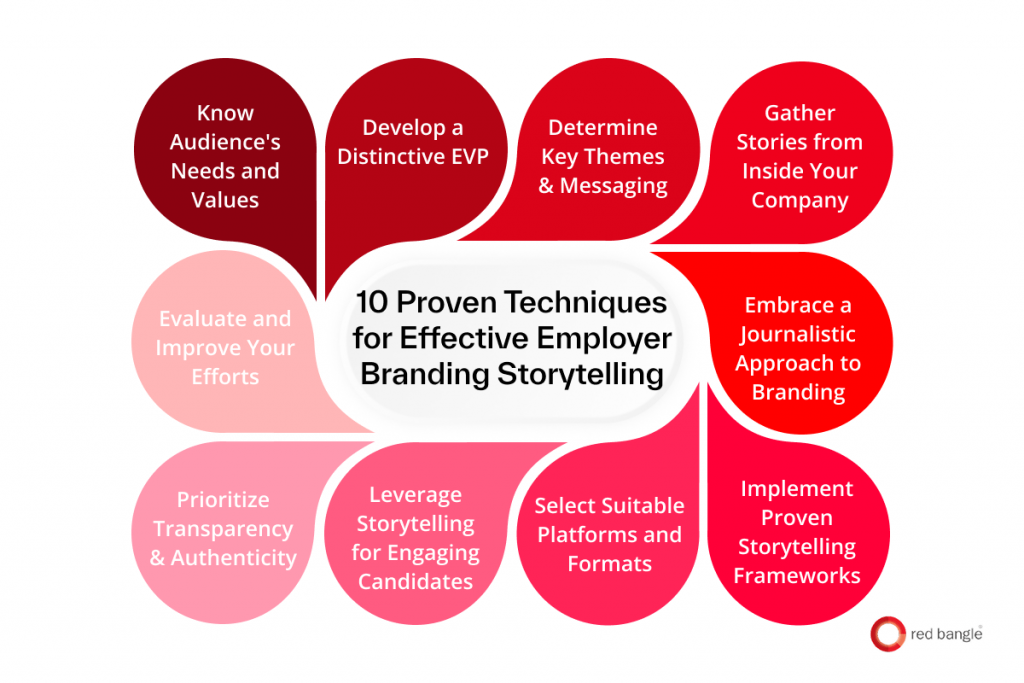
The most successful employer brand storytelling strategies don’t rely on polished slogans; they’re built on truth, empathy, and consistency. The following ten techniques reflect how leading organizations approach storytelling to shape perception, build loyalty, and attract top talent.
1. Know Your Audience’s Needs and Values
To craft effective employer branding stories, you first need to understand your target audience’s values, motivations, and aspirations. What drives them? What challenges do they care about solving? Craft your stories around these insights to ensure relevance and emotional resonance.
For example, if you’re targeting Gen Z candidates, focus on themes like work-life balance, social impact, and flexibility. Use surveys, social listening, and data from job platforms like LinkedIn to uncover these insights, ensuring your storytelling aligns with what matters most to potential hires.
2. Develop a Distinctive Employer Value Proposition (EVP)
Your Employer Value Proposition (EVP) is the core promise of what employees can expect from your company. In fact, according to Gartner, companies with a well-defined EVP experience a 69% decrease in turnover and are 50% more likely to attract passive candidates in competitive talent markets.
Employer brand storytelling should weave your EVP into authentic narratives that reflect the lived experience of employees.
Highlight aspects like work culture, growth opportunities, and leadership development to demonstrate how these align with the expectations of top talent. Clear, consistent communication of your EVP helps create strong emotional connections with potential candidates.
3. Determine Key Themes and Messaging
Identify key themes that are central to your company’s mission and culture, and use these to frame your storytelling. Focus on what candidates value most in the workplace, such as career growth, innovation, or diversity and inclusion.
For instance, if your company emphasizes continuous learning and skill development, use stories that highlight employees’ career progression, learning opportunities, and mentorship. Ensure these themes are consistent across your storytelling to establish a clear and unified message about your culture and values.
4. Gather Genuine Stories from Inside Your Company
Authenticity is a cornerstone of effective employer brand storytelling. Gather real, first-hand stories from employees across various departments, roles, and backgrounds to show the diverse experiences within your organization. These stories should focus on personal growth, team dynamics, overcoming challenges, or making an impact.
When employees share their unique perspectives, it brings your employer brand to life, showing that your organization truly values its people. Authenticity helps build trust, making your company feel more relatable and approachable to potential candidates.
5. Embrace a Journalistic Approach to Branding
Adopt a content strategy similar to that of a media outlet by regularly sharing fresh, engaging stories that highlight your company’s work culture, achievements, and employee experiences. By thinking like a journalist, you create a constant stream of valuable content that keeps candidates engaged.
For instance, share regular “day-in-the-life” features, employee interviews, and company updates that offer insights into your culture. This consistent storytelling builds a more dynamic and evolving narrative, demonstrating that your company is open and transparent.
6. Implement Proven Storytelling Frameworks
A well-structured story captivates your audience and helps them connect emotionally with your brand. Use proven storytelling frameworks, such as the classic “beginning, middle, and end” structure, or the “situation-action-result” (SAR) approach, to create compelling narratives.
Highlight the challenges employees face, how they overcame them, and the positive outcomes that followed. This structure ensures that your storytelling is both engaging and memorable, making your message more impactful and easy to understand.
7. Select the Most Suitable Platforms and Formats for Your Stories
The medium you use to tell your stories plays a critical role in how they are received. Some candidates may prefer short-form video content on LinkedIn or Instagram, while others may gravitate toward in-depth blog posts or podcasts.
Tailor your format and platform to the preferences of your target audience. Video is highly effective for emotional storytelling, while blogs are great for detailed insights and SEO. Social media platforms like LinkedIn are perfect for highlighting leadership voices, while YouTube can be used for more visual and dynamic storytelling formats.
8. Leverage Your Storytelling for Engaging Candidates
Incorporate your employer branding stories into your recruitment materials. Use employee testimonials, success stories, and leadership insights in job ads, career pages, and outreach emails to make your recruitment process more engaging.
These stories should align with the values and aspirations of your target candidates, making them feel connected to your company before they even apply. When candidates can relate to real stories from your employees, they are more likely to engage with your recruitment efforts and ultimately apply.
9. Prioritize Transparency and Authenticity
In an age where candidates increasingly seek out transparency, your storytelling should reflect both the strengths and areas for improvement within your company. Sharing stories about challenges faced by employees or lessons learned shows candidates that your company is open and honest about its culture.
Transparency helps build credibility and trust, as candidates can see that the company is genuinely committed to making improvements and fostering a supportive environment for growth.
10. Continuously Evaluate and Improve Your Storytelling Efforts
Storytelling is an ongoing process, and it’s essential to evaluate its effectiveness regularly. Use data and feedback to track how your stories are performing, particularly in terms of engagement and conversion. Look at metrics such as social shares, comments, application rates, and retention to gauge which stories resonate most with your audience.
Regularly update and refine your storytelling strategy based on these insights to ensure that your employer brand remains relevant and impactful. This process of continuous improvement ensures that your employer brand storytelling evolves along with your company and its audience.
By implementing these employer branding best practices and techniques, companies can build a robust employer brand that attracts top talent, strengthens employee engagement, and differentiates itself from competitors.
Now, let’s see how leading organizations bring these strategies to life through real-world employer brand storytelling examples.
Great Examples of Employer Brand Storytelling
Real-world examples demonstrate how storytelling can move beyond abstract values and turn company culture into an engaging narrative. The employer branding storytelling examples by Red Bangle show how organizations across industries have used storytelling to attract talent, build authenticity, and reinforce their employer brand identity.
1. Infosys: Global Leadership Stories
Infosys wanted to bring its Employer Value Proposition (EVP), “Move Forward. Take The World With You,” to life across its global audience. The challenge lay in showing how leaders grow, mentor, and embody Infosys’ values in real-world contexts.
Red Bangle conceptualized the Employer Branding Series, a cinematic storytelling format that featured leaders from across regions. Each video focused on their personal growth, challenges, and philosophies, connecting the EVP to tangible experiences.
The narrative structure emphasized empathy, inclusion, and global collaboration, qualities that define Infosys’s culture.
The Impact:
The series strengthened leadership visibility and amplified employee pride. It helped potential hires see leadership as approachable and aspirational, while reaffirming Infosys’s image as a company that nurtures growth across boundaries.
2. Treebo: Hotel Superhero
Treebo began its journey in 2015 as a tech-powered business hotel chain. The focus was on providing a dignified experience for budget travelers.
Recognizing the potential of their in-house technology, Treebo decided to create a SaaS platform. This platform would serve hotel owners and operators both in India and globally.
The Hotel Superhero campaign was crafted as a unique employer brand storytelling vehicle to attract top-tier software developers to join Treebo’s mission of scaling their transformative technology.
Through this campaign, Treebo sought to position the Hotel Superhero SaaS platform as a game-changing tool for the hotel industry while showcasing the innovative, tech-driven culture of Treebo.
The Impact:
The Hotel Superhero campaign strengthened Treebo’s employer brand in the tech sector, positioning it as an innovative leader in SaaS for hospitality.
By highlighting software developers as key drivers of change, the campaign attracted top tech talent and emphasized Treebo’s culture of innovation, purpose, and collaboration. It successfully showcased the company as a dynamic, tech-driven workplace, reinforcing its commitment to transforming the hospitality industry.
3. Darwinbox: Culture Video
As an HR tech leader, Darwinbox wanted to differentiate itself as a people-first, future-ready employer in a space often perceived as purely technical. The challenge was to articulate its innovation-driven culture through stories that felt human and relatable.
Through a powerful recruitment film, Red Bangle spotlighted employees who personify curiosity, collaboration, and agility. The storytelling combined workplace authenticity with aspirational energy, positioning Darwinbox as a company where innovation is driven by people, not just products.
The Impact:
The campaign strengthened Darwinbox’s employer identity, helping it attract purpose-driven candidates aligned with its culture. It also reinforced internal pride, showing employees that their stories matter as much as their work. By showing, not telling, how its culture operates, Darwinbox attracts candidates who value purpose-driven innovation.
4. Ashirvad Plumbing School: CSR Film
Ashirvad Plumbing School, certified by the Indian Plumbing Skills Council as a Center of Excellence, aimed to showcase how vocational training can transform lives. The goal was to build sustainable career paths for its students.
The challenge was to highlight not just the technical training, but the larger human impact. This included improving income, employability, and social mobility for its students.
Red Bangle crafted an approach that brought these transformations to life through authentic, first-person narratives.
The film followed students through an intensive 35-day plumbing program, capturing their experiences, aspirations, and newfound confidence. Through candid interviews and real-world success stories, the narrative highlighted empowerment, progress, and the dignity of skilled work.
The Impact:
The initiative demonstrated how purpose-driven skill development can create lasting change. The story resonated deeply because it celebrated real human transformation and social upliftment, showing how storytelling can powerfully communicate impact beyond traditional corporate narratives.
5. Apple: Life at Apple Stories
Apple’s employer brand storytelling focuses on authenticity and inclusion, using written and visual narratives to bring its culture to life. The challenge was to represent its people and values through everyday stories that feel real and human, without relying solely on video.
Through the Life at Apple platform, Apple features diverse employee experiences that highlight shared values like innovation and belonging. In “William – Off to a Running Start”, a retail employee in Shanghai shares how Apple’s inclusive culture empowers him to grow and champion accessibility.
The Impact:
Apple proves that authentic written storytelling can be just as powerful as video. By showcasing real employee voices and moments across its site, Apple builds emotional connection, credibility, and purpose into its employer brand.
6. Google: Life at Google Stories
Google’s employer brand storytelling focuses on openness, innovation, and human connection. The challenge was to present its global culture authentically, showing what it’s like to work across teams and locations, without relying on overly polished corporate messaging.
Through the Life at Google platform, the company shares diverse stories that highlight teamwork, inclusion, and purpose. In A Day in the Life at Google – Data Centre Roles, employees offer a glimpse into their daily experiences, collaboration, and shared passion for solving complex problems.
The Impact:
With video storytelling, Google humanizes its employer brand. These authentic employee narratives help candidates connect emotionally with Google’s mission, reinforcing a consistent and approachable brand identity across markets.
How to Curate Your Employer Brand Story Across Channels
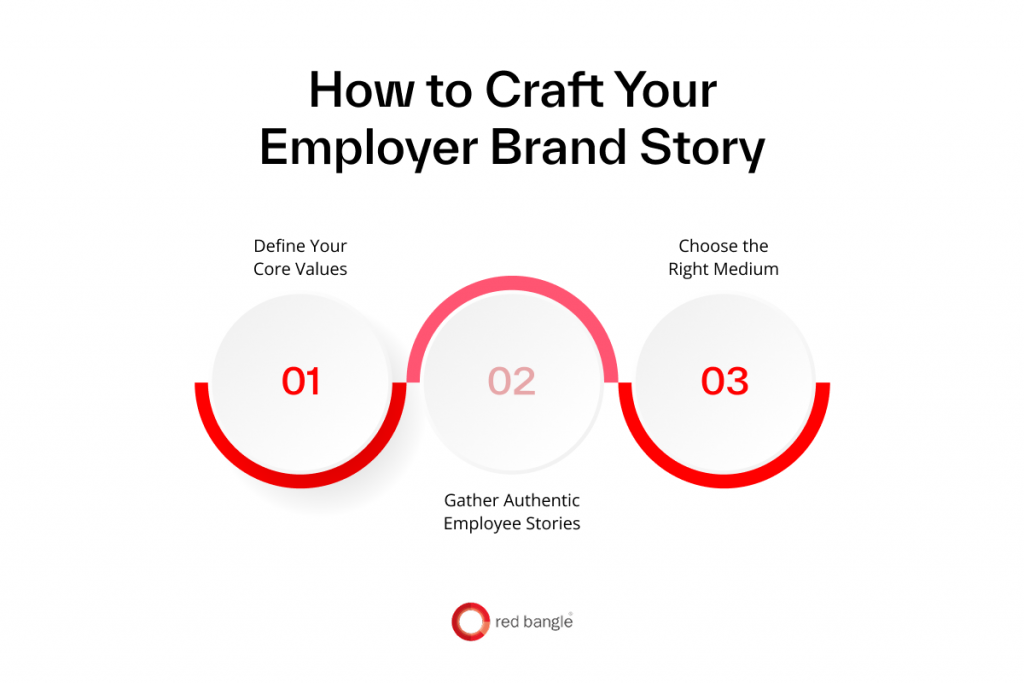
An employer brand doesn’t have a single story or channel; it’s built through many voices and mediums. The goal is to curate these diverse stories, from written employee profiles to leadership videos, into a cohesive narrative that reflects what your organization stands for.
Here’s how to bring those stories to life effectively:
1. Define Your Core Values
A great employer story begins with clarity around values. These principles should guide everyday decisions and interactions, not just exist as corporate statements. When a company’s values are clearly defined, they become the foundation for authentic storytelling.
Red Bangle’s culture film for Zyeta captures this perfectly.
Instead of focusing on architectural achievements, the story highlights collaboration, creativity, and shared passion among teams. The visuals and tone reflect the company’s belief in designing workplaces that inspire people, a clear expression of its values in action.
2. Gather Diverse and Authentic Employee Stories
Employer brand storytelling should amplify many voices, not one. When employees share their real experiences, they turn company values into relatable proof points. These authentic narratives make a large organization feel approachable and human.
Infosys’s “Life at Infosys” film, for instance, gives a glimpse into real employee journeys across roles and geographies, making a large organization feel personal and connected. Such formats show that genuine stories build emotional connection and trust.
3. Choose the Right Formats
There’s no single format for employer brand storytelling. The strongest brands use a mix of media, videos for emotion, blog posts for depth, photography for authenticity, and social content for immediacy.
For instance, Apple’s Life at Apple uses written employee narratives and photography to showcase inclusion, while Google’s Life at Google combines YouTube videos with blog features to humanize its teams. Marriott’s Life at Marriott blog adds yet another layer, using first-person employee articles to highlight belonging and growth.
Conclusion
Strong storytelling in employer branding and communications is a crucial strategy for attracting and retaining top talent. In an era where candidates assess company culture through employee voices, transparency, and online reviews, stories have become vital for building trust.
By weaving authentic, employee-centric narratives with multimedia tools, companies can present themselves as attractive, transparent, and authentic workplaces.
The most effective employer branding strategies combine authenticity and consistency, using storytelling as an ongoing dialogue that connects employees, leaders, and candidates.
Integrating storytelling across career pages, LinkedIn, newsletters, and reviews creates a cohesive, genuine narrative. Ultimately, employer brand storytelling helps companies move beyond polished slogans. It offers a true reflection of company culture, team challenges, growth, and retention.
If you’re ready to bring your employer brand story to life and engage top talent with authentic storytelling, book a call with Red Bangle. Let us help you craft compelling, employee-driven stories that resonate with the candidates who truly align with your mission.